
Pre-Virality Detection: Stopping Disinformation Before It Spreads
July 20, 2026
The Child Is Not a User Segment: Rethinking AI Through Agency and Trust
August 17, 2026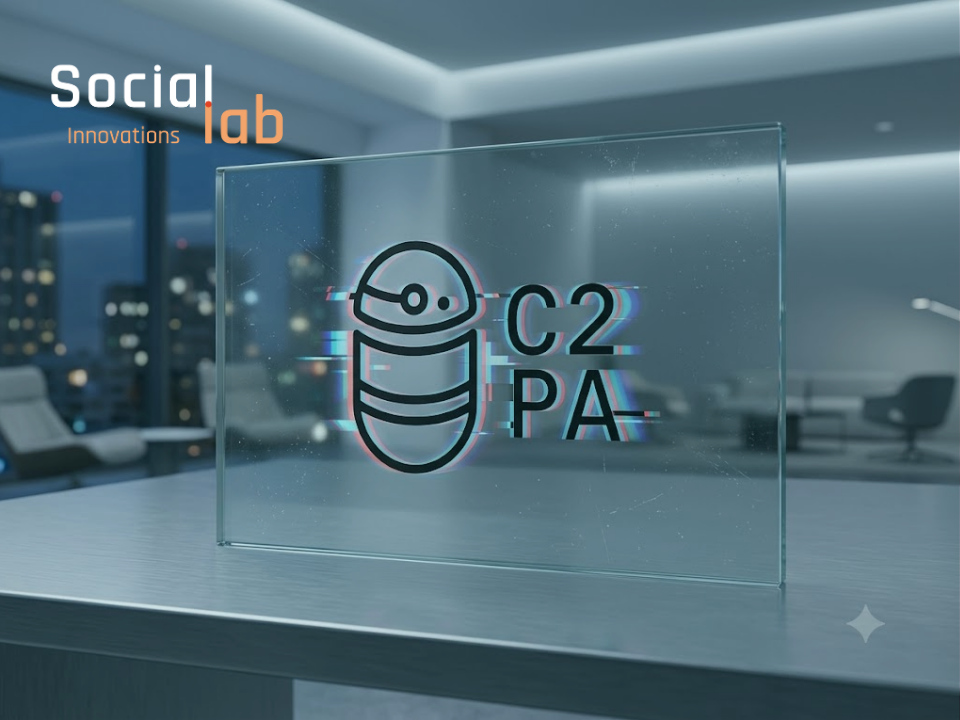
- The August 2026 Compliance Mirage
- Why Watermarks Fail in the Wild
- The Cognitive Reality
- File vs Behavioral Provenance
- The SocialLab Defense
- Actionable Playbook
- Frequently Asked Questions
- Compliance is not immunity. As Article 50 of the EU AI Act becomes enforceable on August 2, 2026, organizations are spending millions adopting C2PA watermarks. A compliant file can still be stripped and weaponized in under 20 minutes.
- Watermarks fail in the wild. Technical credentials are regularly destroyed by standard social media compression, screenshotting, and adversarial noise injection, leaving enterprise content without provenance in exactly the channels where disinformation spreads fastest.
- File provenance versus behavioral provenance. Knowing how a file was generated is useless once the badge has been stripped. True defense requires tracking how the asset moves across fringe networks before it crosses into mainstream channels.
- The SocialLab answer. Effective enterprise defense combines file-level forensic ingestion with pre-virality narrative intelligence, detecting coordinated manipulation signatures before they reach viral velocity.
Watermarks, digital credentials, and content authenticity standards are valuable steps toward a more transparent web. Against an adversary intent on inflicting economic or social damage, a digital stamp is a speed bump, not a wall. The organizations that understand this distinction will be the ones that survive the generative AI era with their reputation intact.
The August 2026 Compliance Mirage
On August 2, 2026, Article 50 of the EU AI Act takes full legal effect across European markets. For enterprise risk officers, CISOs, and communications directors, this deadline has sparked a significant push toward compliance. The statute mandates that providers and deployers of generative AI implement machine-readable transparency obligations, including disclosure of AI-generated content and labeling standards for synthetic media.
The technology landscape has largely rallied around the Coalition for Content Provenance and Authenticity (C2PA) standard and invisible pixel watermarking. Corporate boardrooms are resting on a dangerous assumption: that technical compliance with these standards equals active defense against disinformation. This assumption is a multi-million-dollar fallacy.
A deepfake audio file or forged corporate document can be 100 percent compliant with EU labeling standards at the moment of generation, and still be stripped, repurposed, and weaponized into a viral market panic in under 20 minutes. Compliance is a legal requirement. It is not a security strategy.
The Mechanics of Why Watermarks Fail in the Wild
C2PA works by embedding cryptographically signed manifests directly into file headers. However, the vast majority of viral disinformation does not spread via pristine, high-resolution original files. It travels through compressed, re-encoded, screenshotted derivative copies. Three stripping mechanisms are responsible for most provenance destruction:
The Cognitive Reality: Why Badges Cannot Compete With Emotion
Even in the best-case scenario where an AI-generated badge remains attached to a piece of media, static labels fail against human psychology. As explored in our analysis on pre-virality disinformation detection, human cognition processes emotional visual narratives before it processes textual warnings.
When a user encounters a high-emotion video, for example a synthesized video of a CEO making inflammatory remarks or an emergency director declaring a hazard, the brain processes the visual narrative first. A small label reading AI-Generated in the corner is cognitively outcompeted by the emotional content before the conscious mind has finished parsing the frame. The label is present. The damage is already done.
Key Takeaway for Threat Intelligence Teams: C2PA proves authenticity when present, but the absence of a watermark proves absolutely nothing. Relying on missing watermarks to declare content safe is an invitation to catastrophic exposure. The absence of a badge is not evidence of safety. It is evidence of a stripped file.
File Provenance Versus Behavioral Provenance
If static file verification cannot prevent a crisis, what can? The answer lies in shifting enterprise posture from file provenance to behavioral provenance.
File provenance inspects the digital wrapping of an isolated asset. It asks: how was this file generated? Behavioral provenance evaluates the narrative vector. It analyzes how an asset enters and moves across the digital ecosystem. It asks different questions entirely:
By analyzing the behavior of the narrative rather than relying solely on the file header, security teams can identify malicious deepfakes and manipulated media even after every byte of metadata has been thoroughly scrubbed. The asset is stripped. The behavioral signature is not.
The stripping of a watermark destroys the file provenance. It does not destroy the coordinated behavior that surrounds the amplification of that file. Behavioral provenance captures what file inspection cannot: the attack pattern itself.
The SocialLab Defense Architecture: Truth as an Ecosystem
Through collaborative work with DW Akademie on the Disinfo Demasked initiative, SocialLab demonstrated that truth cannot be maintained by a digital stamp alone. Protecting enterprise value and public stability requires a dynamic, multi-tiered threat intelligence architecture that bridges static file compliance and active behavioral defense.
Multimodal Forensic Ingestion
Instead of discarding media that lacks C2PA metadata, SocialLab's engine ingests the raw media signal alongside available provenance tags. If C2PA data is present, it is validated against trusted public key registries. If it is absent or corrupted, the system does not declare the content safe. It escalates the file to behavioral analysis, treating the absence of provenance as a signal rather than a null result.
Dark Social and Fringe Channel Tracking
Coordinated threat actors rarely launch campaigns on mainstream platforms where C2PA readers are active. They test and refine stripped assets in private community groups, fringe forums, and unmoderated networks. SocialLab's monitoring architecture reaches into these channels to detect coordinated amplification signatures before the asset crosses over into mainstream media cycles, giving organizations the pre-virality window they need to respond.
Grounded Zero-Day Narrative Intelligence
Using few-shot models trained on expert-labeled manipulation taxonomies, SocialLab isolates the underlying attack strategy behind an asset. Whether a bad actor is using an unwatermarked AI video or a heavily edited authentic recording, the system identifies the narrative manipulation vector, classifies it against known campaign archetypes, and flags it for pre-bunking response before it reaches viral velocity.
Actionable Playbook: Moving Beyond the Stamp
As the August 2, 2026 enforcement date passes, security leaders, communications directors, and risk officers must upgrade their defensive posture. Moving from passive regulatory compliance to active threat resilience requires four concrete steps:
Watermarks, digital signatures, and C2PA Content Credentials are valuable for honest creators in compliant environments. Against an adversary intent on inflicting economic or reputational damage, they are a speed bump.
The organizations that navigate the generative AI era with their enterprise value and public reputation intact will not be those that simply checked the compliance box. They will be the organizations that understood what the compliance box does not cover.
Compliance tells you how content was made. Defense tells you what is being done with it.
Frequently Asked Questions
Common questions about C2PA, watermarking, behavioral provenance, and enterprise disinformation defense.
Standard watermarking is no longer enough to defend against today's most advanced deepfake threats.
Discover how SocialLab's specialized threat intelligence architectures help organizations stay ahead of AI-powered deception, from fringe channel monitoring to pre-virality narrative detection.
SocialLab has delivered AI and narrative intelligence systems across 27 countries since 2015. sociallab.ai