
The Watermarking Fallacy: Why C2PA Will Not Stop 2026 Disinformation
July 28, 2026
Navigating the AI Revolution: The MediaAI Compass Guide
September 9, 2026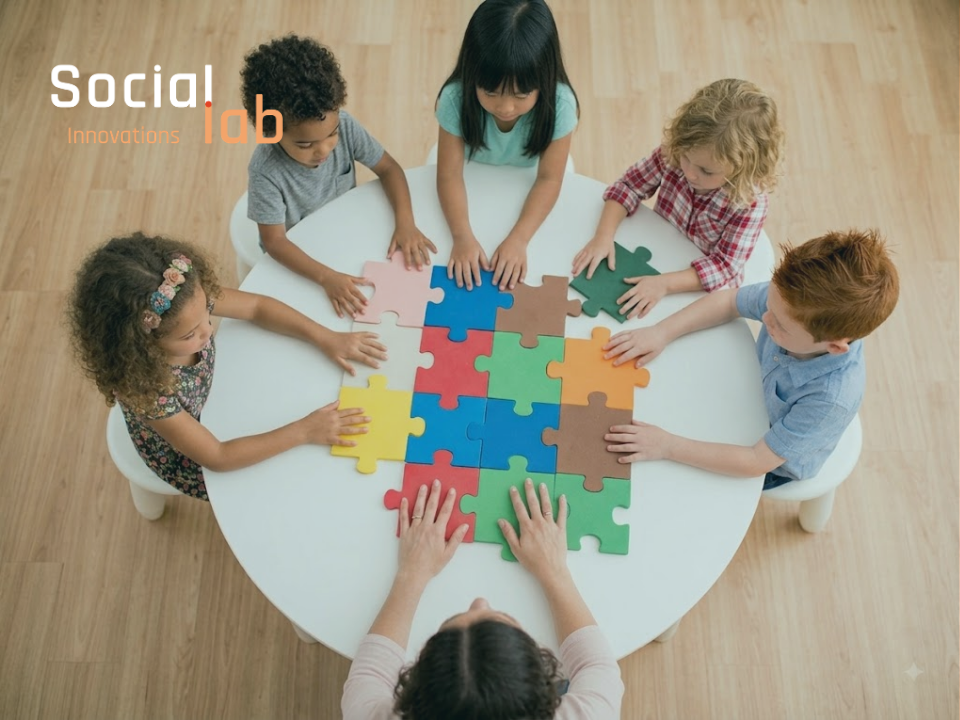
Children do not choose the artificial intelligence that shapes their thinking. Adults choose it for them with every algorithm embedded in an app, every automated assessment, and every data pipeline silently collecting their behavioral patterns in the background.
When EdTech companies speak about children, they often reduce them to market metrics: monthly active users, engagement minutes, or device seats. But a child is not a user segment. A child is a developing human being whose curiosity, safety, and cognitive autonomy deserve uncompromising protection.
That distinction is the foundational engine behind our Child-Centered AI Policy (effective January 01, 2026). It is why we built our learning architecture, from the broader research at SocialLab down to the dedicated SocialLab Academy Child-First Program, around the child as an individual, rather than around the institutional needs of the classroom.
A Radical Shift in Product Design
Here is what changes when you shift the focal point from institutional tech deployment back to the child:
1. Cultivating Epistemic Independence
The dominant commercial software model relies on friction-free loops, dark patterns, and hyper-personalized notifications designed to keep users hooked. When applied to young minds, these mechanics do not foster learning, they create digital dependency.
As we noted in our National AI Education Strategy, the goal of AI literacy should not be to train kids to become passive operators of proprietary tools. It must cultivate epistemic independence, the ability to think, question, and form judgment without an AI intermediary making decisions for them.
Under our Child-Centered AI Policy:
-
No Attention Hacking: We explicitly design against addictive patterns and manipulative UX in every child-facing tool.
-
Building Critical Thinkers: Our algorithms encourage inquiry and independent verification rather than serving "instant correct answers" that replace the thinking process.
-
Child-First Transparency: We explain why an AI tool offers a recommendation in plain, age-appropriate language directly to the child, treating them as an active participant in their own learning journey.
2. Designing for the Margins, Not the Median
As we explored in our analysis on Why the EdTech Industry Is Building AI All Wrong, we highlighted a stark reality: 182 million children live in emergency and crisis contexts, and over 74 million of them are out of school entirely. Most software assumes a child has steady Wi-Fi, a modern tablet, and a stable home environment.
When you design for the child who has the least, the entire product spec changes:
-
Surveillance-Free & Non-Monetized: A child's data is held in trust, never monetized. Human Rights Watch found that nearly 90% of government-endorsed EdTech tools leaked children's data or tracked them for commercial purposes. SocialLab platforms operate with zero third-party tracking, zero advertising, and zero data sales.
-
Offline-First Capabilities: Through the SocialLab Academy Child-First Initiative, learning tools function seamlessly in low-bandwidth or offline environments, ensuring displaced or crisis-affected children are never locked out of learning.
-
Designed for Inclusion: We actively test our models against bias across language, gender, disability, and socioeconomic background so that AI does not perpetuate real-world inequalities.
3. Child Well-Being Over Commercial Gain
Commercial incentives and child well-being frequently end up in tension. When that happens, companies without strict principles default to revenue.
Our policy embeds a clear, non-negotiable directive: The child's best interests—their safety, privacy, and healthy developmental needs—take precedence whenever a commercial consideration and a child’s well-being conflict.
This is not an abstract ideal. It means an empowered, accountable internal child safety lead holds the explicit authority to halt, modify, or strip out any feature across SocialLab Academy or our partner tools if it compromises a child's trust or safety, no matter the business cost.
Shaping Architects, Not Consumers
The next generation will grow up surrounded by AI-driven systems influencing their education, healthcare, and civic choices. The greatest gift we can give them is not just access to tech, but the agency and critical mindset to govern it responsibly.
By publishing our Child-Centered AI Policy in the open, we hold ourselves publicly accountable to this standard. We do not build software to capture a child's attention, we build tools that respect their rights, guard their privacy, and help them thrive on their own terms.
SocialLab Academy
Building AI education that puts the child first — not the platform.
The SocialLab Academy Child-First Program is built around the child as an individual, not an engagement metric. Read our full policy, explore the program, or visit the Academy to see how we design AI learning tools that protect rights, guard privacy, and build genuine critical thinkers.
Our Policy
Child-Centered AI Policy
Read the full policy →
Our Program
Child-First Program
Explore the program →
Our Platform
SocialLab Academy
Visit the Academy →
SocialLab has delivered AI education and social impact programs across 27 countries since 2015. sociallab.ai
Related posts

October 6, 2026
October 5, 2026

September 28, 2026
