Singapore, Estonia, China and UAE: Where AI Moves Beyond the Hype
June 12, 2026
Why Critical Solutions Require Open Data
June 29, 2026
- The Procurement Trap
- What Vendor Lock-In Means
- The Open-Washing Problem
- The Student Data Crisis
- What Students Should Learn
- Seven Countries
- From Consumers to Architects
- Frequently Asked Questions
The next generation of learners will not be judged by how well they used AI. They will be judged by how well they understood it, questioned it, and refused to be shaped by it without their consent. The institutions preparing them for that are not the ones deploying the most tools. They are the ones asking the hardest governance questions.
Something has gone wrong in the way most institutions are thinking about AI and education, and it is going wrong quietly, at scale, before most policymakers have noticed.
The problem is not that schools and universities are using AI. AI in education is producing genuinely valuable outcomes: personalized learning pathways, early identification of students at risk of disengagement, administrative automation that returns hours to teachers, accessibility tools that reach learners who conventional formats were never designed to serve.
As of 2025, only 20% of higher education institutions had issued any AI governance policy. Meanwhile, 92% of higher education professionals report using AI tools, but only 23.6% feel very confident using them. The HEPI 2026 Student Generative AI Survey reveals a stark split: for some learners, AI frees up time for deeper thinking, for others, it is replacing the thinking entirely.
A genuine national AI education strategy requires confronting three challenges most strategy documents avoid: the vendor lock-in trap, the open-washing problem, and the question of what AI should actually develop in students.
The Procurement Trap That Nobody Planned For
The AI tools embedded in schools and universities across the world were not acquired through strategic national planning. They were acquired through the path of least resistance: a compelling demonstration, a free trial, a district-level pilot that became a system-wide dependency. The procurement trap works in four stages that are now well documented.
A vendor offers an AI platform at a subsidized or free entry price. The platform embeds itself into institutional workflow, student data flows into it, teachers build practice around it, assessments calibrate to it. The vendor then raises prices, changes data policies, modifies algorithms, or is acquired. The institution cannot exit because it would require rebuilding its entire educational technology stack.
This is not hypothetical. A landmark global investigation by Human Rights Watch found that 89% of government-endorsed ed-tech products engaged in data practices that directly risked children’s rights or leaked data to advertisers. A 2026 technical audit found that 89.3% of ed-tech apps initiate outbound background telemetry connections to third-party tracking networks the moment they are opened.
The legislative response is accelerating. California’s Assembly Bill 1159, one of 134 active AI-in-education bills being tracked across 31 US states, specifically targets this gap by moving to prohibit ed-tech operators from monetizing student data.
The contrast between South Korea and New York City is instructive. South Korea committed nearly $740 million between 2024 and 2026 to train teachers in advanced AI tools, but when the National Assembly debated AI-powered digital textbooks, lawmakers voted to make adoption a school-level choice rather than a national mandate, understanding that tools deployed without governance are liabilities, not assets. New York City made the opposite bet. Parents packed a Panel for Educational Policy meeting in spring 2026 demanding the DOE pause all AI deployments while the city finalized its governance framework.
The procurement trap is not the result of bad intentions. It is the result of individually rational decisions made without adequate national frameworks that protect long-term interests.
What "Vendor Lock-In" Actually Means in Education
In enterprise contexts, vendor lock-in is primarily a financial and operational risk. In education, it carries three additional dimensions that make it qualitatively more serious.
Pedagogical lock-in. When AI systems determine how students receive feedback, how they are assessed, how learning gaps are identified, and how curricula are sequenced, the pedagogy is no longer defined by educators. It is defined by the model, optimized for outcomes the vendor could measure and monetize.
Epistemological lock-in. When a generation learns primarily through AI intermediaries built on particular models of knowledge and correctness, those models become an invisible layer of assumptions students lack the framework to question. UNESCO warns directly: when educational technologies are developed primarily for financial gain, education becomes a product and students become consumers, and deepening the AI divide.
Sovereignty lock-in. For countries in the Global South building national education systems on top of foreign AI platforms, the dependency is not just commercial. It is a form of technological colonialism: the foundations defining what counts as educated, what counts as correct, and what counts as capable are controlled by external interests. India’s response to this risk is architecturally significant, rather than building on foreign platforms, India constructed the National Digital Education Architecture (NDEAR), a federated, interoperable digital architecture built on open standards and open APIs, deliberately designed so that no single vendor can capture the stack.
The Open-Washing Problem
The response many institutions reach for when confronting vendor lock-in is “open-source AI.” If the model is open-source, the reasoning goes, there is no vendor dependency, no data extraction, no proprietary control. This reasoning is correct in principle and inadequate in practice, and the inadequacy has a name: open-washing.
Open-washing is the practice of marketing proprietary or semi-proprietary AI systems as open while maintaining tight control over their functioning and the critical elements of their technical ecosystem. Despite names that imply openness, many systems keep their essential internal mechanisms under tight commercial or governmental control.
Genuine openness in educational AI requires three things that open-washing does not provide. Open training data — educational AI models must be built on datasets that are auditable and contestable, free from the commercial interests that shape what counts as correct or worth knowing. Open governance — not a GitHub repository, but a decision-making architecture with genuine power for educators, students, parents, and communities. Open educational resources — the active participation of all educational actors in AI governance, treating education as a public good.
Estonia embodies this logic. The AI Leap initiative builds on X-Road, a public interoperability layer that has been open-standard and state-owned since 2001, equipping 20,000 high school students and 3,000 teachers with AI literacy grounded in civic purpose.
The Student Data Privacy Crisis
AI education platforms now collect unprecedented student data: keystroke patterns, eye movements, facial expressions, voice tone, learning speed, and emotional state indicators. This data describes not just what students know but how they think, how they struggle, and what environments they thrive in. It is among the most sensitive data in existence. And in most countries, it is largely unprotected.
Under the enforcement timelines of the EU AI Act, high-risk AI systems deployed in educational settings — those used for admissions, institutional access, student monitoring, or automated learning outcome assessments — must comply with mandatory transparency, human oversight, and conformity assessment requirements. The Act explicitly prohibits AI systems designed to infer the emotions of natural persons, addressing one of the most invasive categories of edtech surveillance.
Finland has built an answer that does not wait for regional enforcement. According to directives from the Ministry of Education and Culture, local education providers must conduct mandatory Data Protection Impact Assessments (DPIAs) prior to deploying any AI tools. Idaho, meanwhile, has enacted SB 1227, establishing a statewide K-12 framework banning AI from replacing human teachers entirely — a blunter instrument than Finland’s nuanced governance, but reflecting the same underlying recognition: without explicit legal constraints, commercial AI interests will govern by default.
What AI Should Actually Develop in Students
Here is the question most national AI education strategies fail to ask clearly: what, precisely, should students be learning about and through AI?
The dominant answer in most strategies is AI skills: prompt engineering, algorithmic thinking, data literacy, technical fluency. These are real and valuable. But they are incomplete, because they position AI as a tool to be operated rather than a system to be governed. The next generation will not primarily be AI engineers. They will be people who live and work in environments saturated with AI-assisted decisions — about credit, employment, healthcare, criminal justice, and education itself. What they need is not primarily the ability to use AI tools. It is the ability to evaluate, contest, and participate in governing them.
Four capabilities go well beyond tool proficiency:
Critical Output Evaluation
Students must interrogate AI outputs, asking not just “is this right?” but “how was this produced, what was it optimized for, whose perspective is embedded in it, and what is it likely to get wrong?” As verification skills increasingly outvalue creation skills in an AI-saturated environment, this is a core competency — not an advanced one.
Algorithmic Accountability Literacy
Students must understand that AI systems encode human choices about what to optimize for and what outcomes to value. Because the vast majority of schools do not teach the risks of algorithmic bias, most students enter adulthood entirely unprepared to recognize when they are being disadvantaged by automated systems.
Governance Participation
The next generation will be governed by AI systems. They need to understand what governance rights they have, how to exercise them, and how to participate in AI governance design. This is a foundational civic education requirement that belongs in every national AI education strategy.
Epistemic Independence
Generative AI makes deep critical thinking and metacognitive skills more important than ever. Students who cannot form conclusions independently — who reach for AI as the first response to any judgment question — are not AI-literate. They are AI-dependent. The curriculum that matters most is the one that teaches them to think without the tool.
What a Sovereign National AI Education Strategy Looks Like: Seven Countries
Different countries are arriving at different answers to the same question. The range of approaches is more instructive than any single model.
Finland’s approach does not lead with AI tools. It leads with national guidelines and legal frameworks defined by the Ministry of Education and Culture that establish strict obligations before tools can be deployed at scale: mandatory Data Protection Impact Assessments, ethical AI use frameworks, and human oversight requirements. Finland’s Elements of AI curriculum — designed not to produce programmers but to produce citizens who can navigate an AI-infused society without being manipulated by it — has become an international reference. AuroraAI and the Eduten adaptive learning platform demonstrate what Finnish EdTech looks like when it is built within a strong governance framework.
Estonia’s bet is that AI literacy is a fundamental dimension of democratic citizenship, not just a technical skill. The national AI Leap (TI-Hüpe) initiative structurally targets over 20,000 upper-secondary students and 3,000 educators, explicitly designing Socratic, inquiry-driven applications to strengthen critical analytical capacity. e-Estonia provides the institutional foundation that makes this civic framing operational.
South Korea has committed massive state funding toward its ambitious AI Digital Textbook (AIDT) initiative. However, when the initial policy push to mandate AI textbooks encountered significant resistance, lawmakers voted to make adoption a school-level choice rather than a national mandate — a significant course correction reflecting the principle that scale without consent is adoption, not transformation. The Ministry of Education is now redesigning the program around teacher agency.
India’s approach to avoiding vendor lock-in is architectural: the National Digital Education Architecture (NDEAR) acts as a federated, open-standard public foundation upon which all educational technology must sit, linking massive national systems like DIKSHA. The IndiaAI Mission and YuvAI programs are rolling out an AI curriculum from Grade 3 upward, aligned with NEP 2020.
The Piauí state model stands as a vital case study for the Global South precisely because it was engineered to function without high-speed internet, expensive hardware, or vendor dependence. The program benefits more than 90,000 students across 540 public schools, has trained more than 680 teachers, and won the UNESCO King Hamad Bin Isa Al-Khalifa Prize for the Use of ICTs in Education. It was designed specifically to avoid the educational sovereignty problem.
The UAE’s approach follows a clear top-down logic: build sovereign foundations first, then develop the native workforce to operate within them. The development of Arabic-first models like Jais 2 from the Mohamed bin Zayed University of Artificial Intelligence (MBZUAI) ensures that regional language and culture are not filtered through foreign models. The government’s commitment to train 80,000 federal employees as Agentic AI experts demonstrates a workforce-first national AI education strategy at speed.
Under its sweeping $2 billion “AI for All” national strategy, Canada’s federal government is providing direct subsidies to democratize AI access for 1 million entry-level post-secondary students and 3,000 educators. An extra $700 million invested in the AI Compute Access Fund reflects the understanding that public supercomputing capacity is an educational sovereignty question, not just an economic one.
These seven country profiles are part of a broader pattern. SocialLab’s National AI Landscapes analysis examines how Singapore, Estonia, China, and the UAE sequenced governance and capability at the national level — the same governance-before-scale logic that distinguishes Finland and Estonia’s education strategies above. For governments and institutions ready to act on these lessons, SocialLab’s open-source National AI Framework turns this analysis into a practical, modular strategy tool, including a dedicated education governance module.
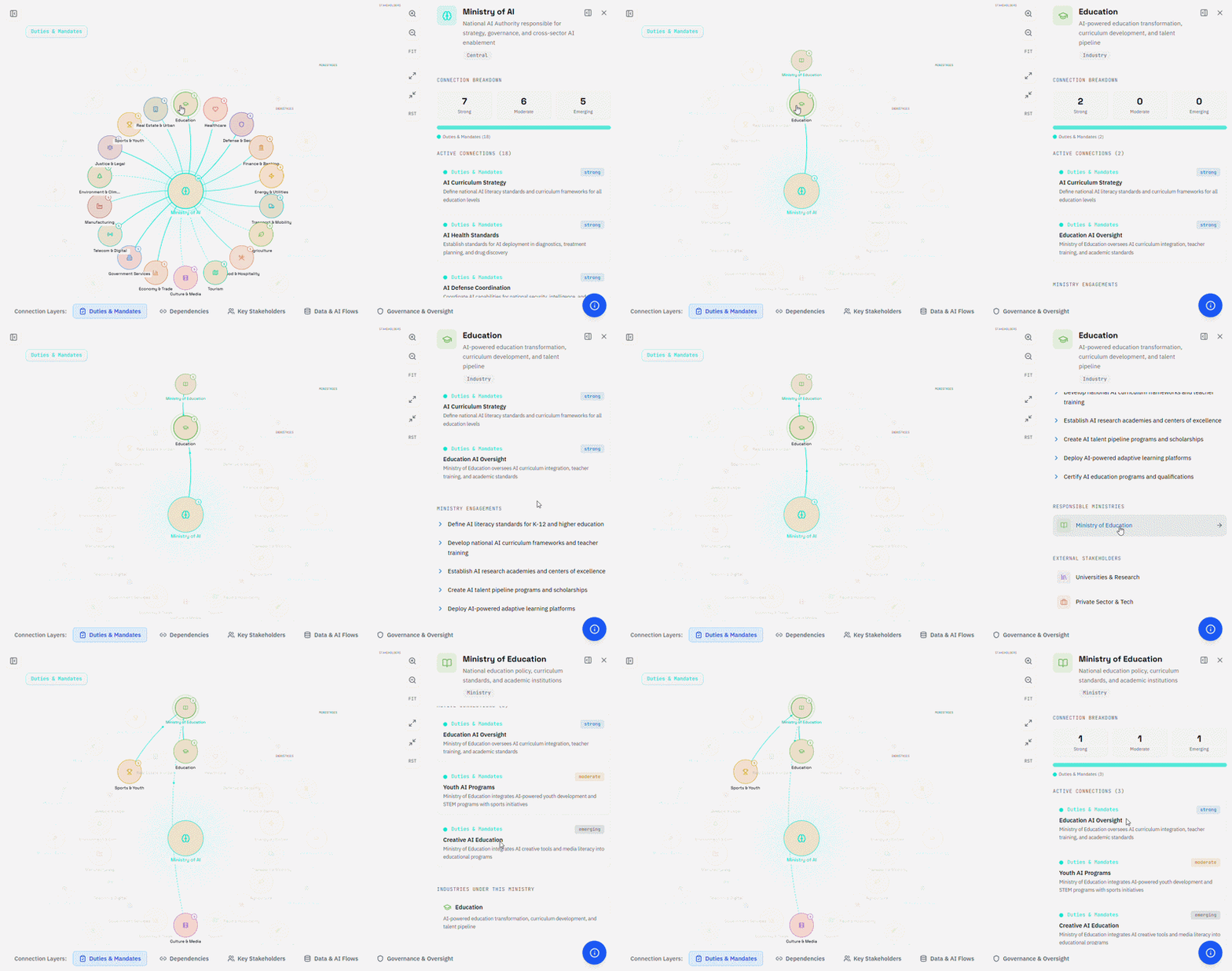
The Interactive Ministry Engagement Map shows how the Ministry of AI sits at the center of national AI capability, linked by duty and mandate to Education, Health, Defense, and other government ministries. Each connection is tagged by strength, with active items like AI Curriculum Strategy showing exactly what the relationship covers.
From Consumers to Architects
There is a generation of students entering education right now who will be the first to spend their entire academic lives in AI-saturated learning environments. What they learn about AI, and what they learn to do with it, to it, and deliberately without it, will determine whether they emerge as architects of AI-mediated society or subjects of it.
The countries generating the most instructive evidence did not treat AI education as a simple procurement choice. They treated it as a fundamental question about what kind of citizens their education systems are designed to produce. When institutions are left to define their own governance, university by university, the result is a dangerously fragmented landscape. When the state defines minimum governance standards — as Finland, Estonia, and India have done — institutions operate within a protective boundary that safeguards students while leaving room for educational innovation.
As explored in SocialLab research on AI maturity: institutions that build robust governance foundations alongside AI capability achieve sustainable integration. Those that deploy tools without establishing governance foundations face severe retroactive remediation costs, regardless of how good the tools were at deployment.
The UNICEF Digital Education Strategy, supporting initial rollout phases across 18 countries through Helsinki’s Global Learning Innovation Hub, demonstrates that this state-level governance approach can be shared across borders. Countries developing their initial institutional capacity can partner with those further along — a model of educational sovereignty that multiplies rather than divides.
The question for every institution, ministry, and policymaker making decisions about AI in education today is not “which AI tools should we adopt?” It is: whose interests does this adoption serve, and are they genuinely the same as our students’ interests?
The answer to that question, honestly given and structurally enforced, is the entire national AI education strategy.
Treating AI as a digital public good is not a utopian aspiration. It is the defining principle that distinguishes a sovereign national AI education strategy from a passive national vendor adoption plan.
We’re building the platform this article describes.
Be among the first to see it.
A platform specifically designed to close the gap between AI tools deployed at scale and the governance, literacy, and sovereignty foundations that make them genuinely serve learners. Built for education — not for vendors.
Governance-first architecture Designed around student data protection, not monetization
AI literacy curriculum Teaches students to govern AI, not just use it
Institutional sovereignty No vendor lock-in by design — open standards throughout
Works everywhere Designed for low-resource environments and diverse contexts
Frequently Asked Questions
Common questions about national AI education strategies, vendor lock-in, and what institutions can do.