
Beyond Black Box AI: Why Transparency is the New Competitive Advantage
May 18, 2026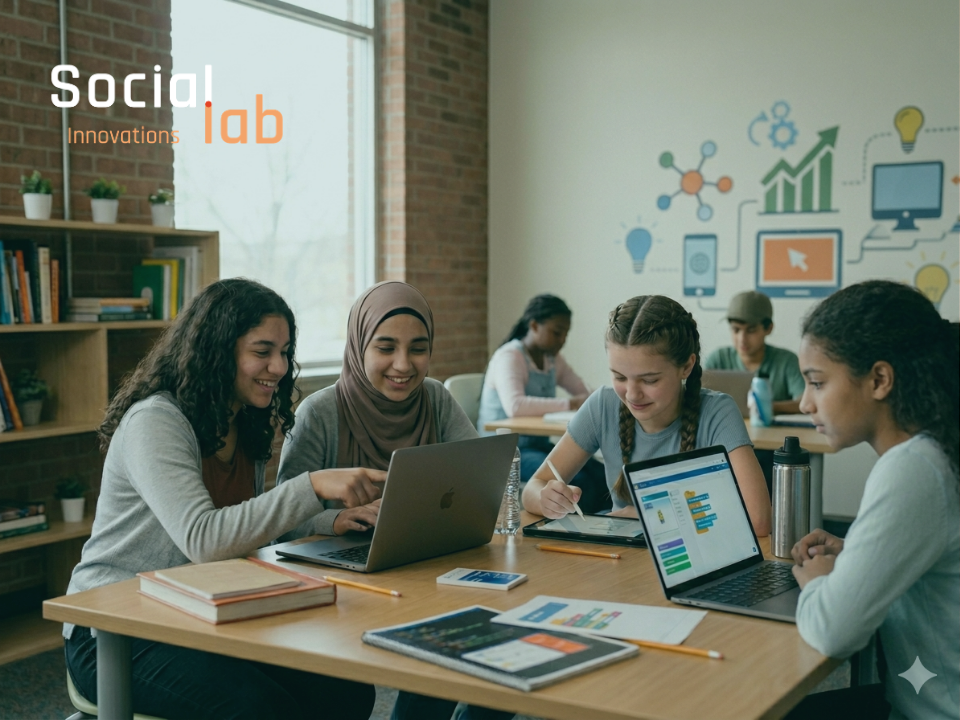
- The Girl Who Was Not in the Room
- Why "Universal" Is Not Neutral
- What Girls Actually Need
- Safe Spaces as Prerequisite
- From Surviving to Shaping
- Inclusive Ecosystems in Practice
- The Stakes Are Not Abstract
- SocialLab Academy’s Commitment
- Frequently Asked Questions
Picture a classroom where technology is being introduced for the first time. There is excitement, a laptop, and a crowd. But look closer at who leans in and who sits back. Across most vulnerable communities globally, the ones sitting back are disproportionately girls.
The Girl Who Was Not in the Room
In the push for global digital transformation, the international community often operates under a dangerous assumption: that distributing devices and building cellular towers is enough to achieve equity. It is not.
In low- and middle-income countries, boys are 1.5 times more likely to own a mobile phone than girls. Despite girls’ desire to connect, restrictive social norms often paint them as unskilled or unequipped, leaving them locked out of the digital world.
At SocialLab Academy, we know that if we build digital platforms for an idealized, abstract “default user,” we inherently lock out the young women who need digital literacy the most. True innovation does not just mean handing out hardware. It means designing learning environments engineered to withstand the real-world, layered constraints that keep adolescent girls offline.
Why “Universal” Education Is Not Neutral
One of the most persistent myths in education design is that a program built for “everyone” actually serves everyone. It does not.
When you design for a generic learner — one assumed to have reliable internet, a personal device, freedom of movement, low barriers to participation, and cultural permission to explore technology freely — you have, by default, designed for a very specific kind of person. And that person is rarely an adolescent girl from a vulnerable community.
The Feminist Design Tool frames this clearly: rather than designing for a “universal user,” ask who is not currently well served and start there. If you solve for the most excluded, you are far more likely to build something that works for everyone.
This is sometimes illustrated with the wheelchair ramp: a feature designed for accessibility that ends up improving movement for parents with strollers, delivery workers, and cyclists alike. The same logic applies to education. When we build learning experiences that work for girls navigating shared devices, limited connectivity, mobility restrictions, and low digital confidence, we are building something more thoughtful, more contextual, and more human than what we would produce otherwise. Equitable support infrastructure is what ultimately turns access into a true learning advantage.
Actions promoting girls’ digital empowerment must engage girls and women as active, capable partners — not passive recipients or targets. This is not just about access. It is about agency. And agency has to be designed from the very beginning.
What Adolescent Girls Actually Need From Digital Education
Before we talk about solutions, we need to talk about realities. Girls and young women, particularly those in underserved communities, face a distinct and layered set of barriers to digital participation. Understanding these is not optional for educators and designers. It is the job.
The Device GapGlobally, boys are considerably more likely than girls to own phones and smartphones. Girls in many emerging contexts rely on borrowed or shared devices, which shapes everything: what apps they can install, whether they can maintain accounts, how much privacy they have in their learning. Any educational program that assumes personal device ownership is already excluding a significant portion of its intended audience.
The Confidence and Literacy GapGirls in many settings have had less exposure to technology through play, gaming, or informal exploration. They often carry the message — from school systems, families, or broader culture — that technology “is not for them.” This shapes how they navigate interfaces, how willing they are to try and fail, and how they respond to being observed while learning.
How we facilitate learning experiences matters enormously: the language used, the presence of peers, whether feedback feels safe versus embarrassing, and whether adults understand the difference between hesitation and disengagement.
The Safety and Privacy GapAdolescent girls face disproportionate risks online, from harassment and exploitation to surveillance by family members on shared devices. Any digital education initiative that does not actively build in privacy protections, safe space design, and safeguarding protocols is not just incomplete — it can cause harm.
Gender-responsive digital design means considering data protection, discretion, and trust as foundational, not afterthoughts. This requires building explicit AI governance and visibility frameworks into educational tools from day one.
The Influencer and Gatekeeper GapGirls often have more gatekeepers than boys when it comes to accessing education and technology. Parents, family members, and community leaders shape these dynamics. To engage with them, we involve families, building community trust before we build curricula.
Safe Spaces Are a Prerequisite
One of the most transformative — and most underrated — investments in adolescent girl education is the safe space.
Not a physical room, necessarily, though that matters too. A safe space is a learning environment designed so that a girl feels genuinely free to speak, ask, explore, and occasionally get it wrong without fear of judgment, mockery, or social consequence.
This is more complex than it sounds. It means thinking carefully about who is in the room. It means using female facilitators who participants can actually relate to — peers or near-peers rather than authority figures. It means sequencing interactions so that trust is built before vulnerability is invited. It means running separate sessions when mixed-gender settings silence girls, and inclusive ones when they do not. Context matters.
Co-designing digital solutions with girls reinforces this consistently: girls are more willing to participate, share honestly, and engage deeply when they feel psychologically safe. And their input, when they are genuinely included, produces better outcomes — better tools, better learning experiences, better retention.
At SocialLab Academy, safe space design is not a box to check. It is baked into how we think about learner experience from the start. Whether we are designing a product, a training program, a workshop, or a learning pathway, we ask: who might feel excluded here, and why? What would it take to make this genuinely welcoming?
From Surviving to Shaping: The Power of Agency-Based Learning
There is a meaningful difference between teaching a girl about technology and teaching her to think with and through technology.
The first positions her as a recipient of a skill. The second positions her as an agent — someone capable of using tools to ask questions, solve problems, create things, and advocate for her community.
This shift matters because adolescent girls in vulnerable contexts are rarely short on insight. They understand their communities’ problems with a precision and nuance that most program designers do not. What they often lack is the language, tools, and platform to translate that understanding into action.
When we talk about future-ready skills at SocialLab Academy, we are not just talking about coding or AI literacy in the abstract. We are talking about building the kind of critical, analytical, and creative capacity that allows young people to participate meaningfully in the decisions that affect their lives.
What Inclusive Learning Ecosystems Look Like in Practice
SocialLab Academy’s approach to youth education, particularly with adolescent girls and vulnerable communities, is grounded in several principles developed through our work at the intersection of AI, human-centered design, and social good.
- Human-centered before tool-centered. We do not start with technology. We start with the person. What are they carrying into this learning space? What barriers exist outside the classroom that will follow them in? What does success actually look like for them, not just for us?
- Contextual and co-created. A learning program designed in isolation from the communities it serves will miss. We believe in involving learners — including young people and girls — in shaping content, format, pacing, and even the norms of how a learning space works.
- Accessible across literacy levels and devices. A program requiring high-end devices and fast internet connections is, by definition, exclusionary. We design with the full range of learners in mind, including those with limited connectivity, shared devices, and varying levels of prior digital experience.
- Safety and safeguarding as design elements. Particularly when working with adolescent girls and young people in vulnerable situations, we embed safeguarding thinking into our curriculum and facilitation practices. This means attending to consent, psychological safety, what information participants share and how, and how our programs connect young people to support networks.
- Mentorship and peer learning. Our CodeHer program, developed in partnership with Deutsche Welle Akademie, creates pathways for women and early-career professionals to build digital journalism and AI skills in collaborative, peer-supported environments. When people see themselves in the people teaching them, they learn differently — more openly, more ambitiously.
The Stakes Are Not Abstract
In 2024, 256 million young people aged 15 to 24 globally were not in employment, education, or training. The AI revolution is reshaping labor markets at speed, and the young people furthest from digital skills are the most exposed to being left behind.
For adolescent girls in vulnerable communities, the risks compound. Without digital literacy, opportunities in education, economic participation, healthcare navigation, and civic voice all narrow. With it, the inverse is true — and the evidence is consistent across contexts.
When girls have equal opportunities and access to quality, inclusive education, their risk of experiencing gender-based violence often decreases, their chances of completing school are higher, and their ability to shape their communities grows. This is not aspirational language. It has a documented impact.
The question is not whether adolescent girls deserve access to future-ready digital education. The question is whether the organizations, educators, and technologists designing these experiences are willing to do the harder, more thoughtful work of building for everyone in the room — including the girl who almost did not come.
SocialLab Academy’s Commitment
At SocialLab, our vision has always been to empower society with advanced technologies from a human-centric perspective, consolidating data science and AI with social and human sciences for genuine social good.
That vision cannot be meaningful if it excludes the young people who most need access to it.
SocialLab Academy is actively developing learning pathways, training programs, and educational resources that center adolescent learners — and that specifically address the barriers faced by girls and youth from underserved communities. This includes designing programs that do not require high-end devices, that work across digital literacy levels, that prioritize psychological safety, and that engage participants as co-creators rather than passive recipients.
We believe that inclusive education is not a niche. It is the standard we should all be building toward.
If you are an NGO, educator, social impact organization, or community partner thinking about how to build more equitable learning experiences for adolescents, we would love to collaborate. Explore our SocialLab Academy programs and our full track record of AI Solutions Across Industries to see how we can build together.
Inclusive education is not a feature. It is the foundation.
Frequently Asked Questions
Common questions about digital inclusion, gender equity in education, and SocialLab Academy’s approach.